How to calm down at work
I was sitting in my office chair one night watching the sun go down around 7:30pm, trying to decide if I should catch up on a file I was behind on, or call it a night and pick it back up tomorrow. I remember scrolling my work chat, seeing who else was still online, and wondering how they were managing. It seemed like some people showed up with a smile to every meeting, while others showed up a bit more begrudgingly, but both still managed to get everything done on time. Everyone had more or less the same amount of work to deal with, but some seemed to manage it a bit better. What were they doing that I wasn’t?
This led me to start researching how to manage stress. I worked with a counsellor, I read books and I subscribed to channels that specialized on wellbeing. If you’re anything like me, most of what you hear might sound like junk at first. My analytical accounting brain was highly skeptical that a breathing exercise could counteract the stress of being behind on several files, or that simply thinking about something differently would help me rationalize the long hours.
But then I got into some of the research behind these methods. I learned how breathing exercises can trigger the parasympathetic nervous system and dissipate stress hormones (cortisol) that flood your system when you’re overwhelmed (Anderson, 2025). I read studies on how mindfulness had strong support for helping people change the way they deal with everything from physical pain, to mental distress, to cancer diagnoses. I discovered that for each external stressors in life, there was an internal process that was taking place in my mind and body. I had little control over the external stressors, but I had a great deal of control over how I dealt with them internally and how they impacted me.
This brings us to distress tolerance and regulation skills. One of my favourite concepts on this topic is the window of tolerance, developed by Dan Siegel in 1991, but still widely used today:
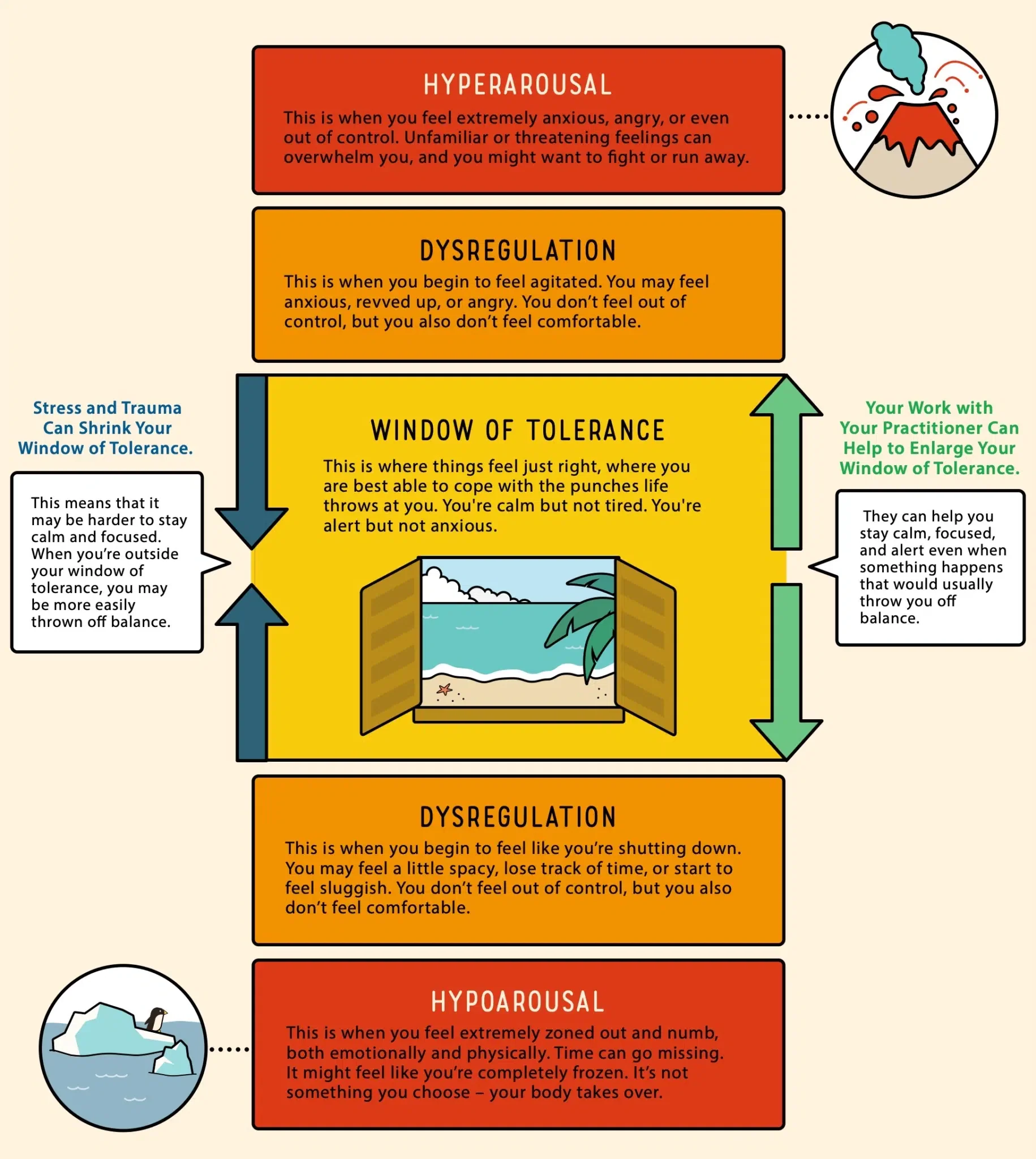
The Window of Tolerance is used to understand states of regulated and dysregulated behaviour.
The window of tolerance is the area where stressful things can happen, but you have the ability to deal with them. Lets say you submit a draft slidedeck to a manager, and later receive a document with 50 review notes. You take a deep breath, power through the review notes and send them back. If you did not have the ability to tolerate this, this might push you into either hyperarousal, or hypoarousal. These look different, but both are your body’s way of trying to deal with something that seems unmanageable. If these review notes felt like the last straw, you might find that your heart rate has increased, you’re feeling overly anxious and maybe even angry and wanting to lash out. All traits of hyperarousal. On the other end, maybe your body feels like giving up is the only way out. In this case, hypoarousal might look like feeling overwhelmingly tired, unable to focus, and numb. Both are forms of dysregulation, and it’s your body’s best attempt at dealing with what you’re experiencing.
The good news is, your window of tolerance is not fixed. This window can expand as you work on yourself and build skills that help you recognize signs of hyper/hypo arousal, and respond to them rather than letting them run you. Improving this over time will allow you to tolerate more stressful things without becoming dysregulated. This is what is meant by being resilient, not simply pushing past your limits. Regulation techniques can look like a breathing exercise, a mantra, or something more unique to you. One common regulation technique you might have seen before is box breathing.
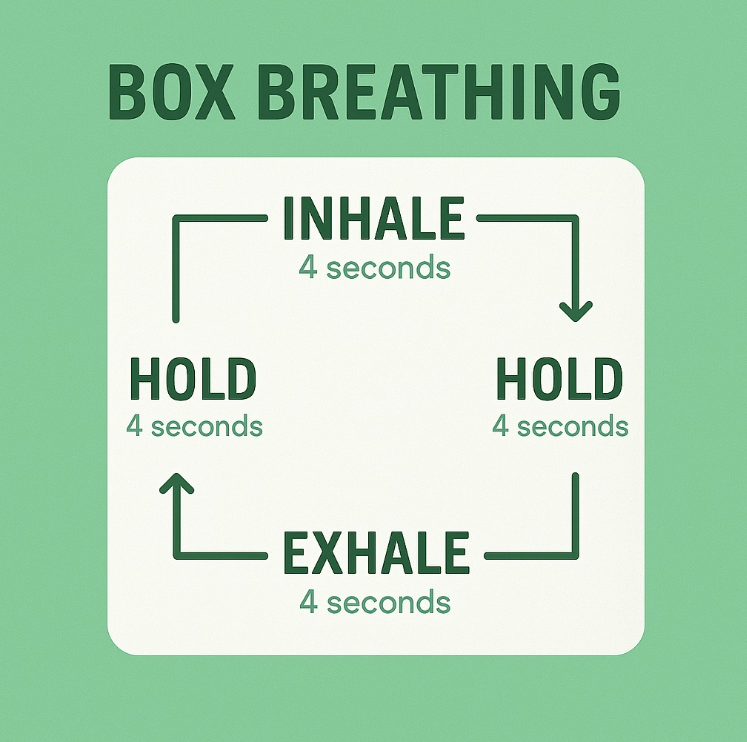
Box breathing is a series of breaths that help ground yourself and slow down.
Box breathing is a structured way of controlling the pace of your breath (Balban et al., 2023). This not only improves the oxygen levels flowing to your brain, but allows you to slow your heart rate down and slow the pace at which you’re operating. If you find that you’re experiencing those early signs of hyperarousal, you can take five minutes aside to simply breathe. This lets you return to the issue with a clear mind, rather than approaching it while you’re on the edge of dysregulation.
While this process sounds simple in theory, there is practice required and sometimes a bit of trial and error is needed to find what helps you ground yourself. This is where working on these skills with a therapist can provide some support and insight that can be hard to achieve on your own sometimes. Over time, you’ll figure out what works for you and lets you deal with whatever life throws at you. If you’re interested in exploring what this looks like, feel free to reach out.